
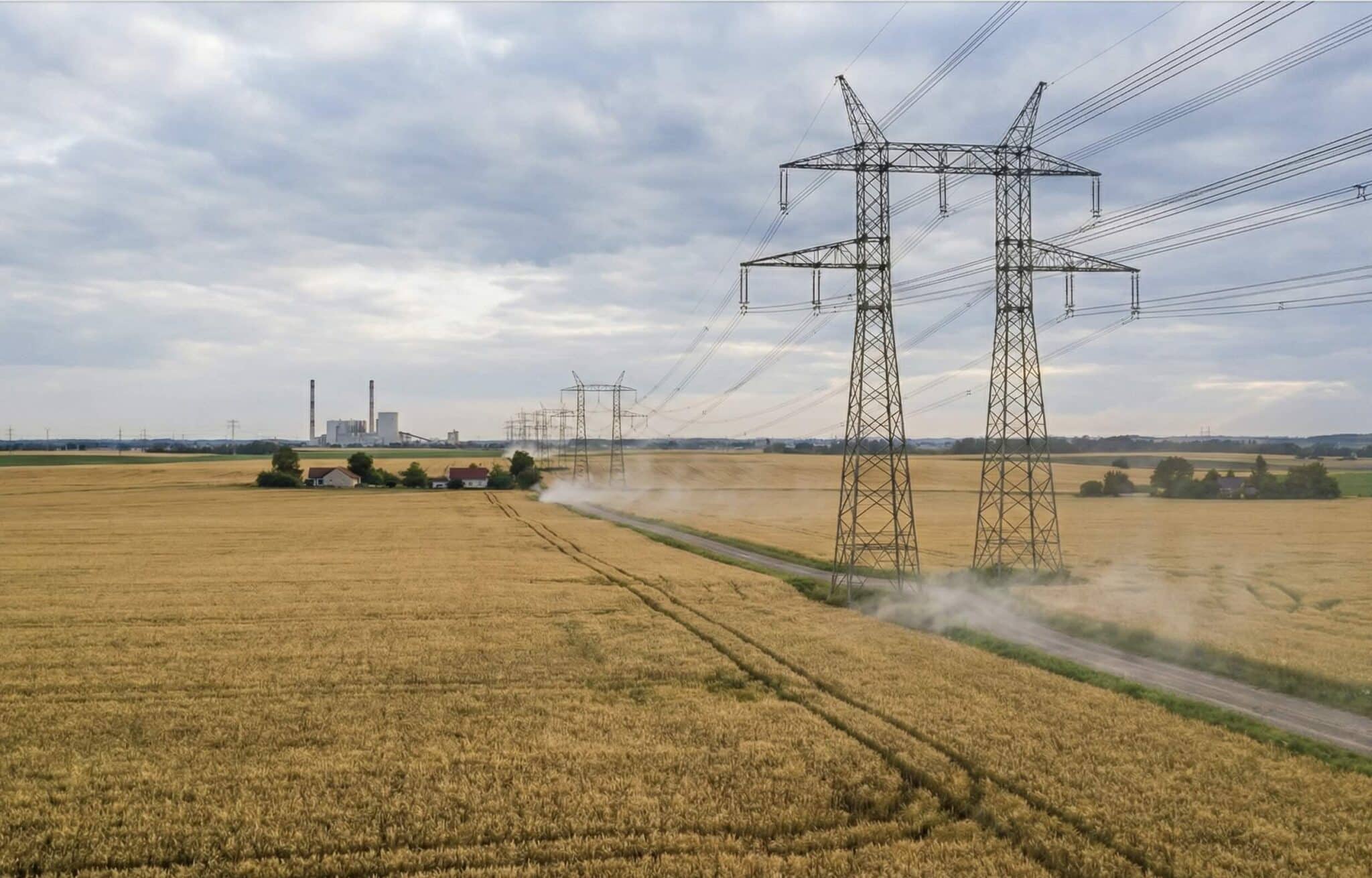
Poland, 21st century. Authentic story of a client of our law firm.
Mr Jan (details amended) runs a large farm. In August he received a parcel from a company in which Mr K. is a partner. In the envelope was a contract signed by Mr K. as agent of the distribution system operator (DSO). According to the contract, Mr Jan had:
- agree to the extension of the OSD electricity grid on its territory
- waive all claims other than compensation for damage to land and crops
Mr Jan did not want to accept this and did not send the contract back. Days passed... Autumn came.
What was Mr John's surprise when he saw his fields one rainy October afternoon! What had happened earlier that day? Well, Mr K. knew that Mr Jan did not agree to enter the field since he had not returned the contract. K. waited for rainy days when farmers do not do field work.
And it was on this day that the „enterprising” Mr K. and his men secretly raided Mr Jan's land and, against the latter's wishes, arbitrarily installed electricity equipment there.
Mr K's team rammed in with six heavy vehicles. The drivers had no mercy for Mr Jan's crops. They drove around the field one next to the other.
The result?
- damaged sowings
- deep ruts
- excavation marks. Mr K. did not dig the earthing in a standard spiral around the poles, but rather in a linear fashion for many metres across Mr John's crop.
Mr Jan is not only a farmer, but also runs a gravel pit nearby.
The deposit extends into the area beneath the damaged fields.
The wide strip of land beneath the earthwork dug by K. has now been excluded from gravel extraction.
Mr K. did not contact Mr Jan. But Mr Jan made an association of facts. He found an unsigned contract in a drawer. He called on Mr K. to reinstate it.
Here, Mr Jan was met with another surprise. Mr K's lawyer responded to his letter by arguing that Mr Jan's failure to send the contract implied his agreement to enter into it! This is a very peculiar view that few lawyers would be prepared to subscribe to.
Unfortunately, it is common knowledge that „in the industry” this is how these matters are often handled. When a farmer defends his property, a „raid” is secretly made on his fields. An OSD employee is usually immediately present on site to inspect the work. In a few days' time, the contractor receives a transfer from the OSD for a job well done....
Here it is worth noting a legal paradox. If someone causes damage to a farmer's crops, this is considered an offence and is punishable by a fine of PLN 500.
But Mr K. destroyed more than just crops. He also destroyed Mr Jan's property. Destroying someone else's property - in this case: real estate - is a more serious matter. The levelling of Mr Jan's land requires work to the value of PLN 40,000. Whether Mr K. and his associates do so can therefore already be considered a criminal offence.
Currently, there is a lot of legal debate surrounding the fact that transmission companies, not only power transmission companies, often invoke the acquisition by way of acquisitive prescription of an easement - as it is referred to in the case law of the Supreme Court - with a content corresponding to the transmission easement. Such a limited right in rem, acquired as a result of the existence of transmission facilities on someone else's land for a period of more than 30 years, would entitle their employees to enter the property in order to carry out, among other things, maintenance work.
Leaving aside doubts as to whether in specific situations the period (20 or 30 years) required to acquire the easement had elapsed, as well as, for example, determining whether the transmission network ran invariably along the same route, and a number of other aspects the verification of which requires specialist legal knowledge, the fundamental question is whether the previous position of the Supreme Court, which generally acknowledges that such an easement - i.e. a land easement with the content equivalent to the transmission easement - could be acquired in a period when the Polish legal system did not exist and the Civil Code did not provide for the possibility of acquiring the easement. The fundamental question is whether the position of the Supreme Court, which as a rule recognises that such an easement - i.e. an easement with the content corresponding to the transmission easement - could be granted at a time when the transmission easement did not exist in the Polish legal system, and the Civil Code already at that time established the principle of the so-called "power of attorney". numerus clausus limited rights in rem and therefore a closed catalogue of them.
In addition to the rule of non-retroactivity of law, which is binding in Poland by virtue of the Constitution, being one of the fundamental principles of the system in a democratic state under the rule of law, attention is drawn to the fundamental difference between this easement, created in fact by the Supreme Court, and having no legal basis until 2008, with the content corresponding to the transmission easement, and the fundamental element of the easements, as the law provided for them before 2008. Well, an easement is established on the encumbered property for the benefit of another property (the so-called ruler). Meanwhile, a transmission easement is not established for the benefit of another property, but for the benefit of the transmission company. And this is one of the main reasons why the Constitutional Tribunal, in its - so far unpublished - judgement of 2 December 2025, issued in the case file P 10/16, stated that the interpretation of the provisions made by the Supreme Court, which allows transmission undertakings to already now obtain a declaration of the establishment of the easement in question in connection with the installation of transmission facilities before 2008, is inconsistent with the Constitution of the Republic of Poland.
PS: It is worth noting that even the Supreme Court itself was not fully convinced of the validity of the view challenged by the Constitutional Court. In its decision of 24 February 2023, ref. III CZP 108/22, the Supreme Court stated, inter alia: „Accepting the existence, in the legal state in force from 1 January 1965 to 2 August 2008, of an easement „with the content corresponding to the transmission easement” and adding the time of possession of such an easement to the time necessary to acquire the transmission easement violates the prohibition of retroactivity of the law expressed, inter alia, in Article 3 of the Civil Code”.
author:
Michał Wojtyczek
This entry contains general information on the legal issue discussed. It does not constitute legal advice or a solution to a specific case or legal problem. Due to the unique nature of each factual situation and the variability of the legal status, we recommend that you seek the assistance of a law firm for legal advice.